 Scan to add on WhatsApp
 Scan with WeChat · click to copy number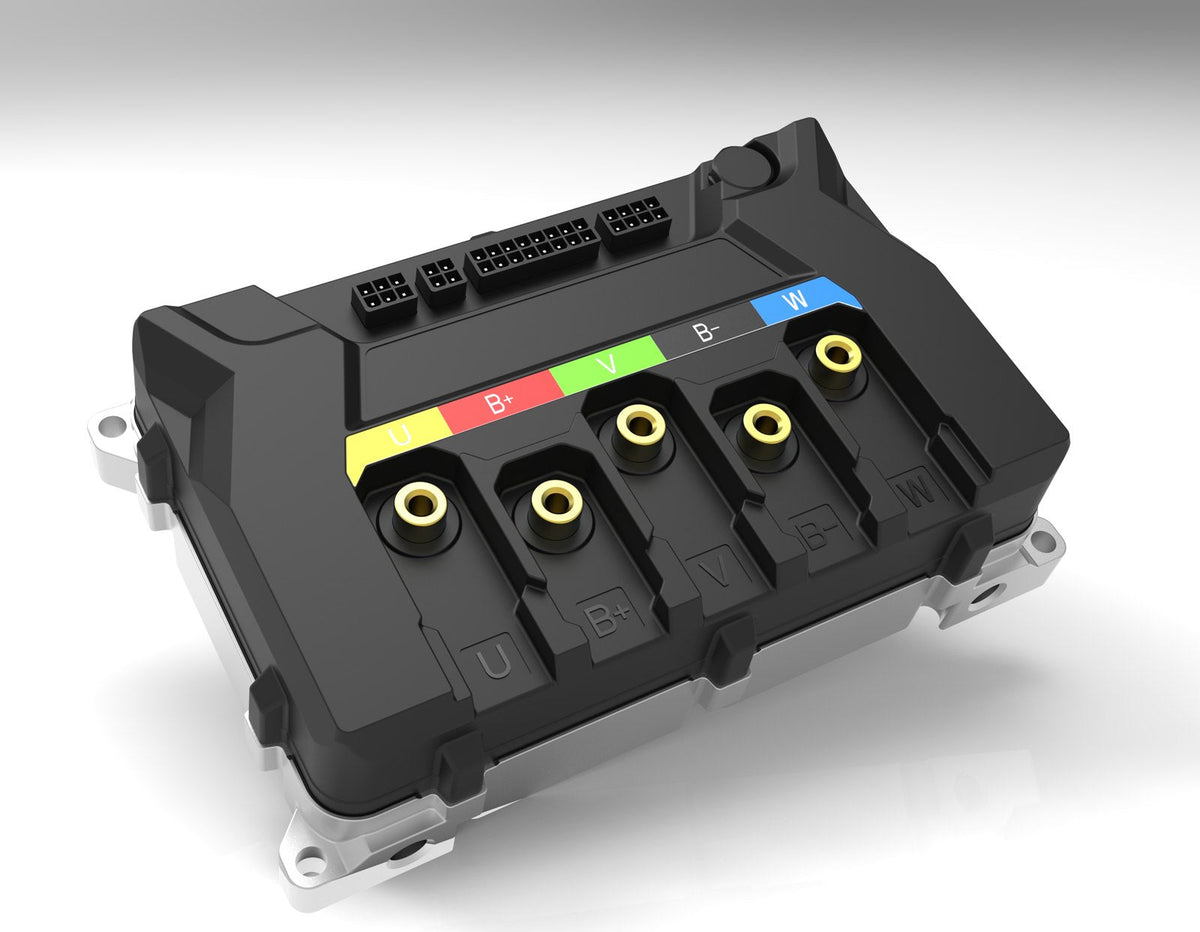
Most low-cost controllers drive a motor with six-step (trapezoidal, "square-wave") commutation: two of the three phases conduct at a time and the controller switches between six states based on Hall sensor signals. It is simple and cheap, but the current jumps at every step. Riders feel this as torque ripple, hear it as motor whine and see it in heat.
What FOC does differently. Field-oriented control measures the phase currents, transforms them into a rotating d/q reference frame and regulates two values directly: the torque-producing current (q-axis) and the flux current (d-axis). The output is a smooth sinusoidal current, generated with space-vector PWM (SVPWM).
What you gain
- Smoother low-speed torque and launch, without the cogging feel of six-step drives.
- Lower acoustic noise, which matters for premium e-motorcycles and scooters.
- Better efficiency at part load, so more range from the same battery.
- Field weakening: by injecting negative d-axis current, FOC extends top speed beyond the motor's base speed.
What it needs. FOC needs accurate rotor position (Hall, GMR encoder or SIN/COS) or a good sensorless observer, plus correct motor parameters. That is why parameter identification matters. Vector's T-Series identifies Ld, Lq, flux linkage and resistance online, and can fall back to sensorless operation if a sensor fails.
Bottom line. For any vehicle where ride quality, noise and range matter, sine-wave FOC is now the default choice. Browse the T-Series FOC controllers or send us your requirements.