 Scan to add on WhatsApp
 Scan with WeChat · click to copy number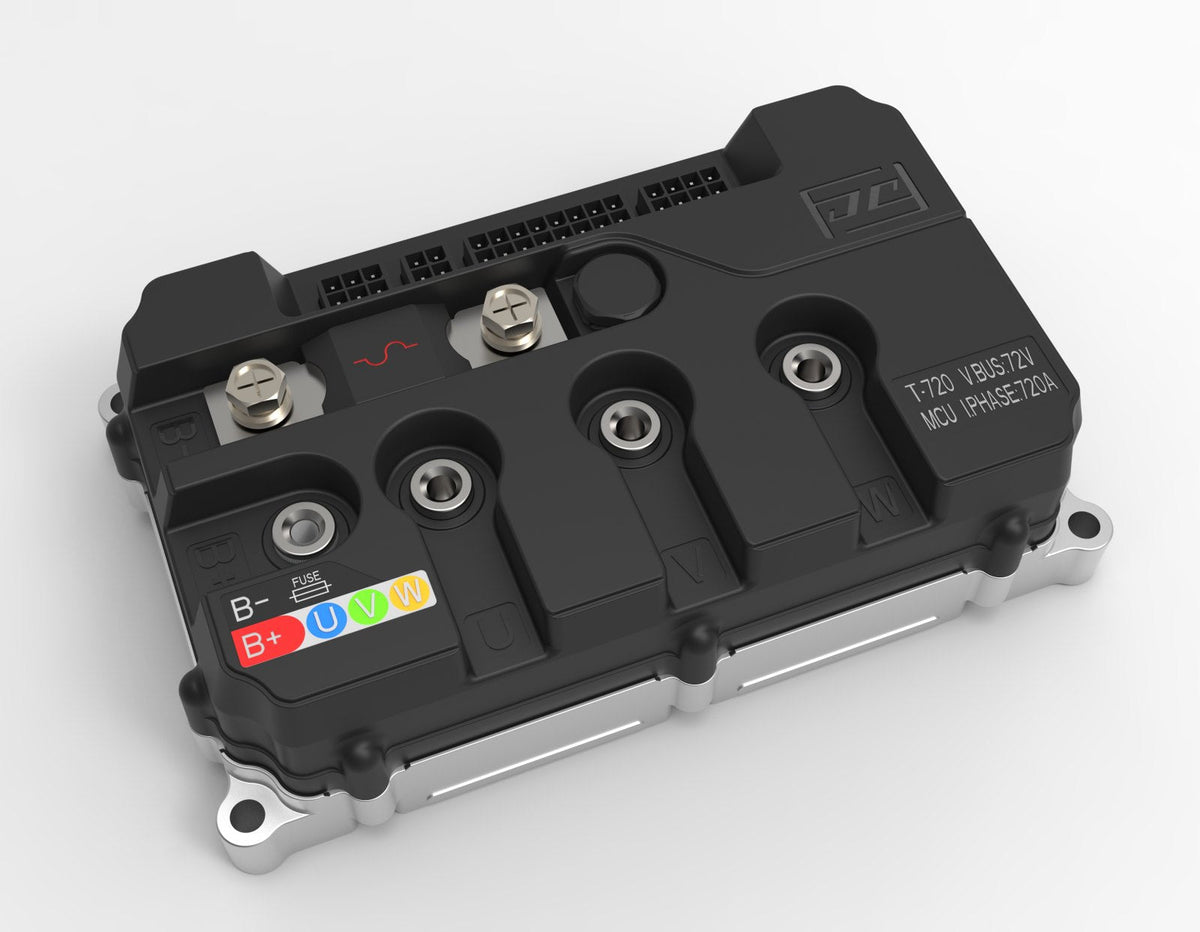
Choosing a controller by "kW" alone is the most common mistake we see. Four numbers matter.
- Battery voltage. The controller's rated voltage platform must match the pack, including its fully charged voltage. T-150 to T-1000 cover 48–72 V platforms; T-1500 and T-2200 cover 72/84/96 V.
- Peak phase current (A). Motor torque is proportional to phase current, so this sets launch and hill-climbing torque. Check the motor's rated and peak phase current and pick a controller with headroom.
- Peak DC bus current (A). This is what the battery must deliver. Bus current × voltage ≈ input power, so it sets top-end power and must stay within the battery/BMS discharge rating.
- Rated vs peak power and cooling. Peak power is a short-duration figure; rated power is what the controller can sustain thermally. If your duty cycle is heavy (cargo, off-road, long climbs), size for rated power, or choose a liquid-cooled version.
T-Series ratings (peak power rated at 72 Vdc)
| Model | Rated kW | Peak kW | Peak DC A | Peak phase A | Cooling |
|---|---|---|---|---|---|
| T-150 | 2.0 | 4.5 | ≤60 | ≤150 | Air |
| T-260 | 3.5 | 7.5 | ≤80 | ≤260 | Air |
| T-300 | 3.5 | 7.5 | ≤100 | ≤300 | Air |
| T-400 | 4.5 | 12.0 | ≤150 | ≤400 | Air |
| T-500 | 8.5 | 18.0 | ≤250 | ≤500 | Air / Water |
| T-600 | 10.0 | 21.0 | ≤300 | ≤600 | Air / Water |
| T-720 | 12.0 | 25.0 | ≤350 | ≤720 | Air / Water |
| T-1000 | 18.0 | 36.0 | ≤500 | ≤1,000 | Air / Water |
| T-1500 | 27.0 | 54.0 | ≤750 | ≤1,500 | Air / Water |
| T-2200 | 40.0 | 79.0 | ≤1,100 | ≤2,200 | Air / Water |
Also check: motor feedback type (Hall, GMR, SIN/COS), communication (CAN for dashboards and BMS), and mounting space. Not sure? Share your vehicle data and an engineer will recommend a model.